Direct Answer
Trenchless sewer repair rebuilds or replaces a buried sewer lateral through two small pits instead of a full-length trench. In Ventura the homeowner owns that lateral all the way to the connection at the city main, so a compliant repair runs past the property line, not only to it.
TL;DR
- Trenchless sewer repair works from a pit at each end instead of a trench along the whole line.
- Two methods cover nearly all residential work. Pipe bursting replaces the pipe, CIPP lining rebuilds it from the inside.
- In Ventura you own the lateral out to the wye or saddle at the city main, under the street [1][2].
- Selling the house requires a camera inspection by a licensed plumber first, unless one was done in the past ten years [1].
- Lining leaves a slightly smaller inside diameter, which counts for more on a four inch house lateral [5].
- Trenchless does not fix grade. A belly stays a belly.
- Start with a camera inspection before pricing any repair.
One liner: Trenchless repairs the pipe you have, and in Ventura that pipe runs further than most owners think.
Key Numbers
| Stat | What it measures | Source |
| Entire lateral length | What the owner maintains, building to the wye or saddle at the public sewer | San Buenaventura Municipal Code 22.210.020 [2] |
| 10 years | Inspection exemption window before a sale | SBMC 22.250.050 [1] |
| January 1, 2014 | When the point-of-sale inspection requirement took effect | SBMC 22.250.050 [1] |
| 6 months | Corrective work deadline, commercial and common interest properties | SBMC 22.250.060 [1] |
| 2 permits | Plumbing plus encroachment, for work reaching the main | City of Ventura Public Works [3] |
| 50 years | Generally accepted service life of a cured-in-place liner | Iowa SUDAS Design Manual, Ch. 14 [5] |
| Ordinance 2026-008 | Code currency, passed May 12, 2026 | SBMC [1] |
What trenchless sewer repair means
In short: Trenchless sewer repair fixes or replaces a buried sewer line through two small pits instead of a trench dug along its whole length.
Your sewer lateral is the buried pipe that carries waste from the house to the city sewer, and it is the pipe behind most sewer line repair and replacement work. Trenchless repair rebuilds that pipe from the inside or pulls a new one through its path, working from a pit at each end rather than an open trench between them.
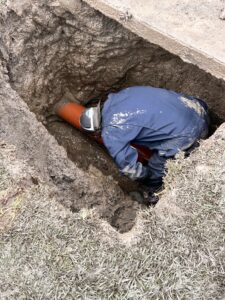
The name oversells it a little. No dig sewer repair is a promise about your yard surface, not about the ground. Crews still dig, at each end. What stays closed is everything in between, which is usually the lawn, the driveway or the patio.
Two methods handle nearly all residential work, pipe bursting and CIPP lining. Both are covered further down, along with how to tell which one suits your pipe.
In Ventura, your sewer lateral goes further than your property line
In short: In Ventura you own the sewer lateral all the way to the connection at the city main, and selling the house triggers a camera inspection first.
The city’s own code is blunt about the boundary. All laterals and house sewer lines running from the public sewer to private property, “including the wye or saddle at the public sewer,” are maintained at the property owner’s expense [2]. The lateral is your property, and the code states it is not part of the public sewer [1].
| Section of pipe | Who maintains it |
| House to the property line | Property owner |
| Property line to the city main, wye or saddle included | Property owner |
| The city main itself | City of Ventura |
Selling the house adds a step. Before any sale, a licensed plumber has to run a camera inspection of the lateral, and the report goes to the buyer with a copy filed at the city [1]. An inspection in the past ten years, or a lateral built in the past ten years, clears the requirement.
If the report finds defects, the city sets the deadline for the repair. The fixed six month limit that gets quoted around town applies to commercial properties and common interest developments, not to a house sale [1].
All of which changes how you read a bid. A trenchless quote that stops at the property line is not a finished repair in Ventura. Ask whether the price covers the run out to the wye at the main.
How does trenchless sewer repair work?
In short: A crew cameras the line, cleans it, pulls a permit, digs a pit at each end, installs the new pipe through the old path, then cameras it again before backfilling.
The sequence is the same whichever method your pipe calls for. What changes is step five.
- Camera and locate. A CCTV run finds the damage and maps where the pipe sits. That same footage is what the city’s inspection report has to include [1].
- Clean the line. Roots, grease and sediment come out first, which is a professional drain cleaning A liner installed over debris takes the shape of the debris.
- Pull the permits. The property owner is responsible for any required city permits before construction starts [1]. Work that reaches the connection at the main also needs an encroachment permit from Public Works, since that stretch sits in the city right-of-way [3]. Your plumber usually handles both.
- Dig the two pits. One near the house, one out toward the connection at the main.
- Install the new pipe. Either a bursting head pulls new HDPE through the old line, or a liner goes in and cures in place. Which one fits comes next.
- Camera again, then backfill. The closing camera run is your proof the work is sound.
How long it takes depends on the run length, the method and the cure, not on a fixed number of days. Notice where the second pit lands. That is the boundary from earlier showing up as a hole near the street.
Trenchless sewer line replacement or lining, which one fits your pipe
In short: Bursting replaces the pipe, lining rebuilds it from the inside. The condition of your existing line decides which one is available to you.
Both are trenchless. Only one of them is a replacement.
| Pipe bursting | CIPP lining | |
| What happens | A bursting head fractures the old pipe outward and drags new HDPE in behind it | A resin-soaked tube is pressed against the pipe wall and cures into a new pipe inside the old one [4] |
| Best when | The pipe is collapsed, badly offset, or you want a bigger line | The pipe is still in one piece but cracked or root-intruded, or it runs under a slab you cannot pit |
| Leaves you with | A new pipe at the same size or larger | A new pipe with a slightly smaller inside diameter [5] |
| Watch for | More ground movement along the run, so nearby utilities need clearance | The lost bore, which counts for more on a four inch house lateral than on a city main |
That last row is the part nobody mentions. A liner is a pipe inside a pipe, so the finished bore is narrower than what you started with [5]. On a four inch lateral carrying a full house, that is worth asking about before you sign. Local crews doing pipe bursting and boring will tell you which one your camera report points to. The short version: pipe intact, line it. Pipe broken, burst it.
When trenchless does not work
In short: Trenchless repairs the pipe. It does not move the pipe. Anything wrong with the line’s slope or position stays wrong.
That rules out more jobs than most homeowners expect. If your camera report shows a belly, a low spot where water pools, a liner will follow the sag and the pooling continues. Fixing grade means opening the ground.
- A fully collapsed run. There is no path left for a liner or a bursting head to follow, and severe offset joints can do the same.
- Nowhere to put a pit. If a structure sits over the launch or receiving end, there is no way in.
- Utilities crowding the path. Bursting pushes soil outward as it goes, so nearby gas, water or conduit needs clearance, which is where underground utility repair and locating work comes in.
None of this makes trenchless the wrong choice. It means the camera report decides, not the brochure.
Trenchless sewer repair in Ventura, what to expect
In short: Expect two holes, one by the house and one out near the street, and expect the work at the street end to need its own permit.
The second pit is where the ownership rule stops being paperwork. It lands in the parkway or the sidewalk area, out toward the connection at the main, because that is where your pipe ends. Any plumber in Ventura quoting this work should price that stretch.
That pit near the street is why the second permit exists, and why the ground it sits in belongs to the city rather than to you [3].
Before any of this, get eyes in the pipe. Midtown includes a free camera scope of the sewer pipe with any service, and that footage is the same recording the city wants filed with an inspection report. One visit answers whether you need trenchless at all, so schedule a camera inspection before you price a repair.
Frequently Asked Questions
In short: The questions below cover the Ventura rules, the two methods, and what to ask a contractor before you sign.
Do I need a sewer inspection to sell my house in Ventura?
Yes, in most cases. A licensed plumber has to camera the lateral before the sale, with the report going to the buyer and a copy to the city. An inspection or a new lateral within the past ten years clears the requirement [1].
How do I know a trenchless repair was done right?
Ask for the closing camera footage. The city’s inspection report format expects a recording of the CCTV run, so your plumber should have one either way [1]. Watch it with them and ask them to point out the new pipe at both ends.
Can pipe bursting make my sewer line bigger?
Often, yes. Bursting fractures the old pipe outward, which leaves room to pull in a larger one, so a four inch lateral can come back as six inch. Lining cannot do this, since a liner works inside the pipe you already have.
Why does my plumber only offer one trenchless method?
Sometimes the pipe allows only one. Sometimes it is the equipment on the truck. Ask what the camera showed and which condition rules the other method out. A clear answer to that question tells you most of what you need to know.
How long does a cured liner last?
Plan on decades, not years. Public engineering guidance puts the generally accepted service life of a cured-in-place liner at 50 years [5]. That is an industry expectation rather than a warranty, so ask your installer what they guarantee in writing.
Does trenchless sewer repair need a permit in Ventura?
Plan on two. Building and Safety issues the plumbing permit, and the owner carries the obligation to get it before construction starts [1]. Work in the public right-of-way, which includes the stretch out to the main, also needs an encroachment permit from Public Works [3]. Most plumbers pull both, so confirm it was done.
Definition Bank
| Term | Meaning |
| Sewer lateral | The buried pipe carrying waste from your building to the public sewer main. |
| Wye or saddle | The fitting where your lateral joins the city main. In Ventura it is the far end of what you own. |
| Trenchless | Any method that repairs or replaces a buried pipe through small pits instead of a trench along its length. |
| Pipe bursting | A method that fractures the old pipe outward while pulling a new one through its path. |
| Bursting head | The cone-shaped tool that breaks the old pipe and drags the new pipe behind it. |
| CIPP lining | Cured-in-place pipe. A resin-soaked tube pressed against the pipe wall and hardened into a new pipe inside the old one. |
| Access pit | The hole dug at each end of the run so equipment can reach the pipe. |
| Belly | A low spot where the pipe has lost its slope and water pools. Trenchless does not correct it. |
| CCTV inspection | A camera run through the line that records its condition. Ventura’s inspection report requires the recording. |
| Backwater device | A valve that stops sewage flowing back toward the building. Ventura’s inspection report notes whether one exists and its condition. |
| Encroachment permit | The Public Works permit needed for work inside the city right-of-way, separate from the plumbing permit. |
Entity Cards
Pipe bursting
| Property | Value |
| Category | Trenchless replacement method |
| Mechanism | Bursting head fractures the host pipe outward |
| New pipe material | HDPE |
| Can upsize | Yes |
| Requires | An access pit at each end, clearance from nearby utilities |
| Best fit | Collapsed, badly offset, or undersized lateral |
CIPP lining
| Property | Value |
| Category | Trenchless rehabilitation method |
| Mechanism | Resin-impregnated tube cured against the host pipe wall |
| Governing standard | ASTM F1216 [4] |
| Effect on bore | Slightly smaller inside diameter [5] |
| Expected service life | Generally accepted at 50 years [5] |
| Best fit | Intact pipe with cracks or root intrusion, or a run under hardscape |
Private sewer lateral, City of Ventura
| Property | Value |
| Ownership | Property owner. Not part of the public sewer [1] |
| Extent of responsibility | Building to the wye or saddle at the public sewer [2] |
| Inspection trigger | Prior to any sale, or on written notice from the city [1] |
| Inspection method | CCTV by a licensed plumber, with the recording filed [1] |
| Permit obligation | Property owner, before construction [1] [3] |
| Governing chapter | SBMC Chapter 22.250 |
Sources
- City of San Buenaventura. Municipal Code Chapter 22.250, Private Sewer Laterals, sections 22.250.040, 22.250.050 and 22.250.060 (current through Ordinance 2026-008, passed May 12, 2026). https://sanbuenaventura.municipal.codes/SBMC/22.250.060 Accessed October 20, 2026.
- City of San Buenaventura. Municipal Code 22.210.020, Sewer Connection Permit, subsection B7, on maintenance of all laterals and house sewer lines from the public sewer to private property, including the wye or saddle at the public sewer, at the expense of the property owner (current through Ordinance 2026-008, passed May 12, 2026). https://sanbuenaventura.municipal.codes/SBMC/22.210.020 Accessed October 20, 2026.
- City of Ventura, Public Works. Encroachment Permits. https://www.cityofventura.ca.gov/393/Encroachment-Permits Accessed October 20, 2026.
- ASTM International. ASTM F1216, Standard Practice for Rehabilitation of Existing Pipelines and Conduits by the Inversion and Curing of a Resin-Impregnated Tube. Latest edition listed F1216-24a. The full text sits behind the ASTM paywall. https://store.astm.org/f1216-24a.html Accessed October 20, 2026.
- Iowa Statewide Urban Design and Specifications. SUDAS Design Manual, Chapter 14, Trenchless Construction, section 14C-2, Pipeline Rehabilitation. 2013 edition with pages revised 2016, posted as Chapter_14-2019.pdf. https://www.intrans.iastate.edu/wp-content/uploads/sites/15/2019/12/Chapter_14-2019.pdf Accessed October 20, 2026.