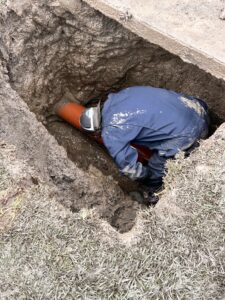
Direct answer: Hydro excavation is soft digging with pressurized water and a vacuum, which pulls slurry into a spoils tank. It exposes buried utility lines without a bucket. California law makes hand tools the default within 24 inches of a marked line. Vacuum excavation is allowed there once the line’s owner agrees and the ticket says so [1][2].
Crews also call it hydrovac. It’s the water-based form of vacuum excavation. The sections below cover how a dig runs, when a property needs one, and what it costs in Ventura County.
What Is Hydro Excavation?
In short: a water wand cuts the soil, a vacuum lifts it, and a spoils tank holds it.
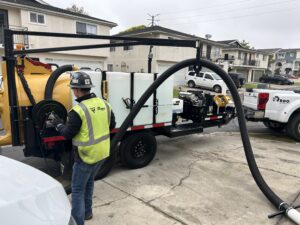
Think of a pressure washer and a shop vac working the same hole. A hydro excavation rig has three main parts. A water wand sends pressurized water into the ground to cut and loosen the soil. A vacuum hose lifts the mud and water as fast as it forms, and everything lands in a spoils tank on the truck or trailer.
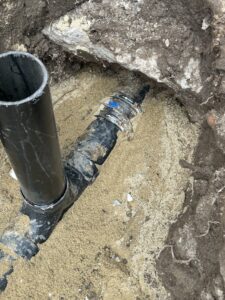
What’s left is a narrow, straight-walled hole with the buried utility in plain view. The crew can check the line’s depth and condition before any repair starts. The slurry usually rides away in the tank for disposal.
The same method goes by other names depending on the job: soft dig, potholing, or daylighting. Soft dig covers any digging that keeps a bucket away from the line. Potholing and daylighting both mean opening a small hole to confirm where a line sits and how deep it runs.
California’s 24-Inch Rule: Where Vacuum Excavation Fits
In short: the law decides when a hydrovac can dig next to a marked line, so ask who files the ticket.
Under California Government Code 4216.4, hand tools are the default inside the 24-inch zone around a marked line [1].
That zone is called the tolerance zone. Section 4216 of the same code sets it at 24 inches on each side of the paint or flag the utility places. If the mark lists the line’s size, half that size gets added on each side [2]. A mark for a 4-inch line, for example, covers 26 inches each side, a band 52 inches wide.
Section 4216.4 allows vacuum excavation inside that band only when three things are true [1]:
- The utility has marked its line.
- The crew has contacted each utility whose line may be in the way, and that utility agreed to vacuum excavation.
- The crew stated it plans to use vacuum excavation when it pulled the DigAlert ticket.
Without that agreement, the crew finds the line by hand first. So before a dig, ask three questions. Who files the ticket? Does it note vacuum excavation? Who calls the utilities? Midtown Plumbing files the DigAlert ticket for its own digs [5].
When Does a Property Need Hydro Excavation?
In short: when a dig has to reach a buried line, work in tight access, or cut clay, cobble, or wet sand.
A property needs hydro excavation when a dig has to reach a buried line that a bucket could strike. Tough ground and tight access count too.
- A marked utility inside the work area, where the crew needs the line’s exact spot and depth before anything else digs.
- Gas piping past the meter, the customer-owned line that feeds a pool heater, a generator, or a restaurant kitchen.
- A sewer lateral, its cleanout, or the city connection, opened at the damaged spot before a repair.
- Entry and exit pits for pneumatic boring and pipe splitting [6], or for trenchless water line replacement [7], with every crossing potholed along the path.
- A narrow slot trench for a new water, gas, or conduit run through roots and irrigation lines.
- Tight access, such as alleys, HOA drive aisles, pavers, and backyards a heavy truck would damage.
Ventura County ground adds its own reasons. Inland clay swells and shrinks with the seasons. River cobble around Ojai, Santa Paula, and Fillmore snags a bucket and drags rock across pipe. Near Pierpont and on the Oxnard Plain, sand and shallow groundwater collapse open trench walls. Water and suction handle all three, and the vacuum pulls water out as the hole deepens [5].
Midtown Plumbing offers hydro excavation services in Ventura County with its own trailer-mounted hydrovac [5]. The crew that opens the hole makes the repair.
How Hydro Vac Excavation Works, Step by Step
In short: scope, mark and file, locate private lines, dig, document, then backfill and haul.
A typical hydro vac excavation runs in six steps.
- Scope the job. The crew learns where the line is, how deep it may run, and what sits on top of it, from photos, plans, or a walk-through. A written quote comes before the rig rolls.
- Mark the area and file the ticket. The crew outlines the dig area in white, then notifies DigAlert at 811 [2][3]. State law requires at least two working days’ notice, not counting the day of the call, and no more than 14 calendar days [3]. Any vacuum excavation plan goes on the ticket [1].
- Locate private lines. Utilities mark only their own lines, so private lines on the property get a separate locate [2].
- Set up and dig. The crew protects the surrounding surface, cuts the soil with pressurized water, and vacuums the spoils into the tank.
- Expose and document. The crew photographs the line’s depth and condition, then makes the repair or hands the open hole to the next trade.
- Backfill and haul. The crew backfills and compacts the hole, then hauls the spoils off site.
What 811 Marks and What It Leaves to You
In short: 811 usually marks the utility’s lines up to the meter, so private lines past it need a separate locate.
Before digging, the excavator has to notify DigAlert 811 [3]. DigAlert sends the ticket to its member utilities, and under state law each one marks only the lines it owns or maintains [2]. The City of Anaheim, a DigAlert member utility, puts it plainly: it marks its lines, usually up to the meters, and does not mark private lines [4].
That leaves gaps. The statute exempts a property owner whose lines serve only that property from joining DigAlert [2]. Lines past the meter often go unmarked: the water service to the house, the yard gas line, irrigation, and power to a spa or outbuilding. The dig law leaves non-pressurized sewer lines out of its definition entirely, so a gravity sewer lateral may carry no mark at all [2].
Picture a typical yard. Fresh paint stops at the water meter box by the curb, and the 40 feet of pipe from there to the house shows nothing. A private locate fills that gap. Midtown Plumbing locates the private water, gas, sewer, and irrigation lines DigAlert does not mark [5].
Hydro Excavation vs. Backhoe vs. Hand Digging
In short: hydro excavation exposes lines, a backhoe moves bulk soil once lines are found, and hand tools are the legal default near marks.
Here’s how the three common ways to open the ground compare.
| Factor | Hydro excavation | Backhoe | Hand digging |
| What removes the soil | Pressurized water and a vacuum | A steel bucket | A shovel and digging bar |
| Inside the 24-inch zone, under state law [1] | Allowed with the utility’s agreement and a ticket note | Not the default, hand tools come first | The default |
| Hole | Narrow, straight walls | Wide trench | Small, shaped by hand |
| Spoils | Held in a tank, hauled off | Piled beside the hole | Piled beside the hole |
| Best fit | Exposing lines, tight access, sand, clay, cobble | Open ground with lines already found | Small, shallow holes |
Many jobs use more than one: soft dig to find the line, then whatever the rest of the work needs.
What Hydro Excavation Costs in Ventura County
In short: compare the hourly rate, the minimum, and disposal, then get a written quote.
If you’re comparing hydro excavation near me, check three numbers in any quote: the hourly rate, the minimum, and how disposal is billed. Here are Midtown Plumbing’s posted rates for hydro excavation in Ventura County [5].
| Item | Midtown rate |
| Hourly | $300 per hour, two-hour minimum |
| Half day | $1,200, up to four hours on site |
| Mobilization | Included in Ventura and Oxnard |
| Off-site disposal of clean spoils | From $225 per load |
A two-hour pothole job in Ventura or Oxnard comes to $600 before any off-site disposal. Depth, soil, and access set the time on site, and sand digs faster than dry clay or cobble. Long hose runs add setup time. Every job gets a written quote first, so call (805) 765-3995 to price yours.
Frequently Asked Questions
In short: six follow-ups on vacuum excavation, who files the ticket, gas strikes, ticket life, high priority lines, and the downsides.
Is vacuum excavation the same as hydro excavation?
Hydro excavation is one type of vacuum excavation. The Common Ground Alliance describes vacuum excavation as pulling soil out by vacuum, commonly after water or air jets break up the ground [8]. Hydro uses pressurized water, and air excavation uses compressed air. Air leaves dry spoils, and hydro leaves a slurry that goes into the tank.
Who files the DigAlert ticket, the homeowner or the contractor?
Under state law, whoever does the digging files it [3]. If you hire a crew, that’s the crew’s job. Midtown Plumbing files the ticket for its own digs.
What happens if a dig hits a gas line?
State law requires the crew to notify the line’s owner right away, and call 911 if gas is escaping [1]. The law counts more than breaks as damage, so the crew reports nicks, dents, gouges, and damaged coating too [1].
How long is a DigAlert ticket valid?
A DigAlert ticket is valid for 28 days from the day it’s issued, under state law. If work runs longer, the crew renews it online or by calling 811 by the end of day 28. If it lapses, digging stops until a new ticket is issued and every utility on it has responded [3].
What changes near a high-pressure gas or petroleum line?
Within 10 feet of a high priority line, state law has the line’s owner set up an onsite meeting. Digging can’t start until that meeting is done [3]. The law’s high priority lines include natural gas lines running above 60 psi, petroleum pipelines, and electric lines of 60 kV or more [2].
What are the downsides of hydro excavation?
Spoils come out as slurry, so they leave in the tank instead of going back in the hole. Off-site disposal adds a per-load charge, shown in the cost table above [5]. On a large open dig where every line is already found, a backhoe can be the better fit.
Sources
- California Government Code Sec. 4216.4, Excavator duties in the tolerance zone, amended Stats. 2018, ch. 708 (AB 1914). https://leginfo.legislature.ca.gov/faces/codes_displaySection.xhtml?lawCode=GOV§ionNum=4216.4
- California Government Code Sec. 4216, Definitions, text current as of January 1, 2026. https://leginfo.legislature.ca.gov/faces/codes_displaySection.xhtml?lawCode=GOV§ionNum=4216
- California Government Code Sec. 4216.2, Notification and tickets, text current as of January 1, 2026. https://leginfo.legislature.ca.gov/faces/codes_displaySection.xhtml?lawCode=GOV§ionNum=4216.2
- City of Anaheim, Digging Safely, a DigAlert member utility (accessed October 2026). https://www.anaheim.gov/6264/Digging-Safety
- Midtown Plumbing Company, Hydro Excavation Services in Ventura County, CA (updated October 2026). https://midtownplumbingco.com/hydro-excavation-ventura-county/
- Midtown Plumbing Company, Underground Utility Repair and Boring (updated September 2026). https://midtownplumbingco.com/underground-utility-repair-boring/
- Midtown Plumbing Company, Trenchless Water Line Repair (updated September 2026). https://midtownplumbingco.com/trenchless-water-line-repair-ventura-county/
- Common Ground Alliance Best Practices Committee, TR2009-09 Vacuum Excavation, approved July 15, 2010. https://www.gti.energy/wp-content/uploads/2019/01/CGA-Vacuum-Excavation-Best-Practice-July2010.pdf